Goliath's Armor
GenZ vs. the 1900
The story of David and Goliath is one of those stories most people think they know. A small boy fights a giant. The giant loses. The underdog wins. It's a simple tale about courage beating size.
But the part that rarely gets attention is the story of Goliath's armor and what it stands for.
Before David went out to face Goliath, King Saul offered him his own armor. Full protection. Helmet, chainmail, sword. The best the army had! David tried it on. And then he took it off. His words, roughly: "I can't move in this. It's not mine. It's not for me." He picked up five stones and his sling instead.
King Saul's armor wasn't bad at all, it was worthy of a King! But it was built for a specific kind of fight: close combat, heavy infantry, the way wars had been fought for generations. And Goliath was exactly that kind of fighter: Nine feet tall, full bronze, built for one thing. But David wasn't a soldier. He was a shepherd. And a sling in the hands of a shepherd wasn't a toy. It was a long-range weapon, accurate and fast. David didn't win despite being smaller, weaker and untrained in war. He won because he refused to fight on Goliath's terms and Conditions and using it against him.
That story is roughly three thousand years old. The pattern in it hasn't aged a day. Let's dig into that:
King Saul's Offer
Someone close to me, Gen Z, loved baking. Had loved it for years. Was really good at it. After a long search, she found an apprenticeship at one of the most prestigious, oldest hotels in Berlin. The kind of place that has been running since the early 1900s. Tradition, reputation, resources. On paper, the perfect start. For the CV: amazing.
What followed was the full weight of that tradition. The worst shifts, assigned work without explanation or introductions. Weeks of repetitive tasks, without anyone teaching her the basics first. Management that operated on volume, not guidance. Low pay, barely a stipend, with meals as the main compensation.
She's also neurodivergent. The system had no concept of that, it seems. Not in its schedules, not in its communication, not in its expectations. Even without the neurodiversity her neurotypical colleagues suffered under that system greatly. The armor was offered in one size. She was expected to fit.
The pattern was consistent across her class. Those in traditional, established businesses had similar bad experiences. Those who landed in smaller, newer bakeries reported something different: better management, better treatment, actual teaching. But those businesses had almost no financial support. They couldn't afford meal stipends. They couldn't afford a lot of things. The old system has the resources. The new system has the approach. Neither has both of the best.
Afterwards, she left the industry entirely. Not because she stopped loving it. Because the system made it unbearable. Last anyone checked, she's living abroad, and most certainly not in the food/baking industry.
Someone who wanted to be in the trade. Who had the talent and the drive. Lost — Not to a competitor. Not to a better opportunity. But to a system that couldn't adapt its own way of fighting with heavy armory.
Planting A New Tree
There's a sentence that tends to come up when this pattern gets discussed: "We had to go through it too!"
It's usually said by someone who survived the same (often abusive) system. And it's often said with conviction, not cruelty. They genuinely believe the hardship shaped them. And in some cases, it probably did. (Into what is an entire different Conversation.) The world those systems were built for was a different one. Hierarchies that made sense in factories, in armies, in economies where labor was abundant and alternatives were few. The armor fit because the battlefield demanded it.
But somewhere along the way, something shifted. "We had to go through it so you don't have to" became "we had to go through it, so you do too." Suffering stopped being a problem to solve and became a rite of passage to protect.
That shift is the moment the system stops evolving. Progress, in almost any definition, means the next generation has it better than the last. Not because it's handed to them, but because the previous generation learned something and changed the conditions. When that learning gets replaced by repetition, the system isn't passing down wisdom. It's passing down pain.
So when did "it should get better" turn into "you have to earn the right to suffer less"?
Goliath Laughs
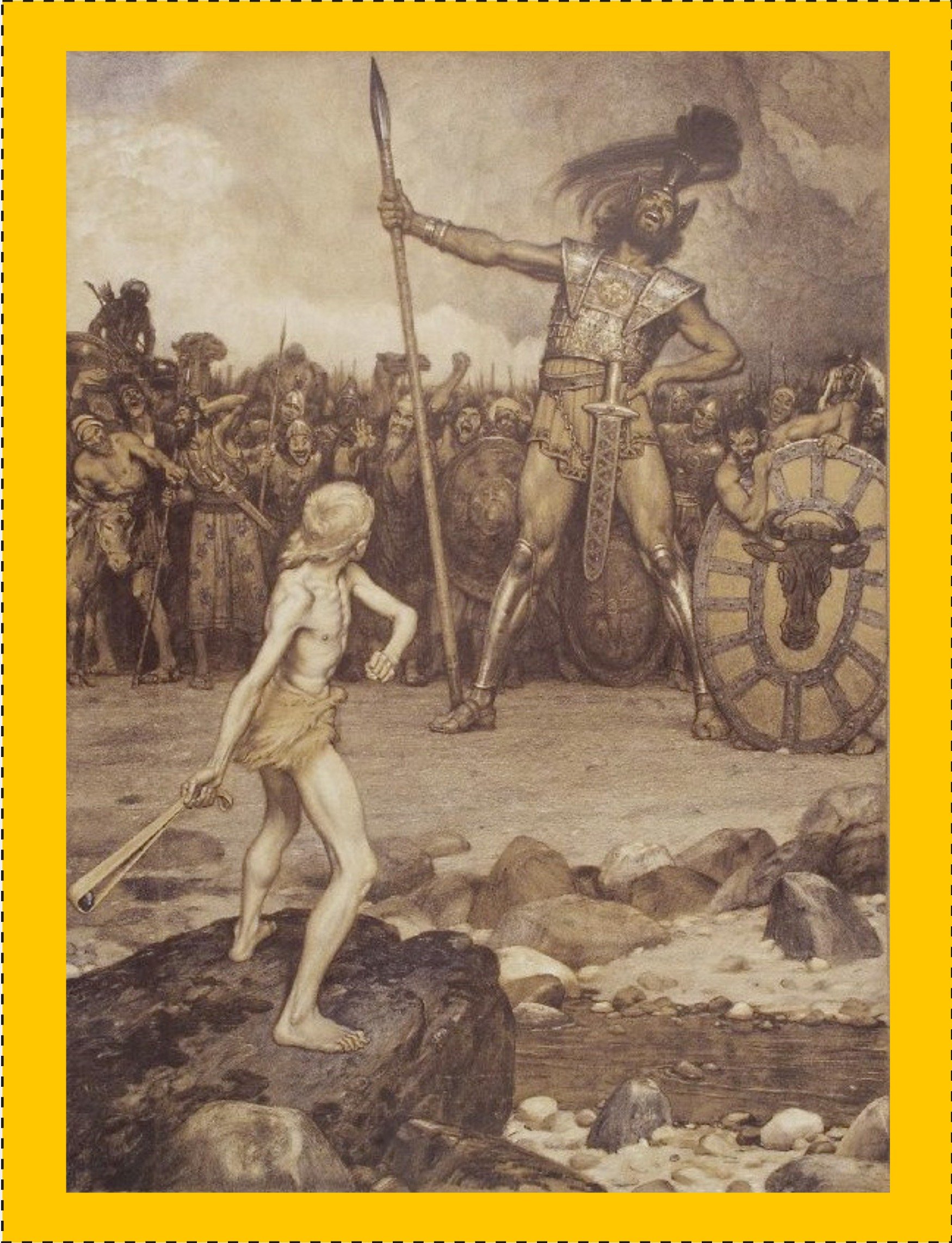
David and Goliath (1888) by Osmar Schindler
Goliath's first reaction to David wasn't fear. It was laughter. A boy with a stick sling and stones, no armor, no sword. By every standard Goliath knew, this wasn't a real opponent. It was an insult.
The reaction from established systems toward Gen Z follows the same pattern:
"They want purpose AND a four-day week?"
"Your Generation is so lazy, you don't want to work full time!"
"They're not willing to put in the effort to climb the corporate ladder."
It has never once been accurate. Let's be clear about this,- it's not a diagnosis: It's a reflex. And the reflex isn't coming from individuals. It's coming from a role that has been running the same response for decades. The system doesn't understand why someone would reject the deal, so it labels the rejection as weakness.
But Gen Z isn't rejecting work. They're rejecting the conditions. The armor. The expectation that suffering to this degree is the entrance fee. And like many previous generations, they have options and some options they do not. Not because they're privileged, but because the labor market has shifted. In Germany alone, the skilled labor shortage in trades and hospitality isn't caused by a lack of people who "want to work". It's caused by a lack of conditions people are willing to accept.
The system doesn't have a people problem. It has a deal that nobody is signing anymore.
And then the stone hits. Not with drama. Not with a fight. Gen Z just leaves. Quietly. The bakery closes. The restaurant can't find staff. The trade loses a generation of talent. And the system that refused to adapt calls it "a crisis".
Is it, really?
The Sling
There's a second pressure on this system, and it doesn't come from any generation. It comes from technology. Every time a new tool arrives, the reaction follows a familiar script.
Calculators: "They'll forget how to do math."
The internet: "They'll stop reading books."
Search engines: "They'll stop remembering facts."
AI: "They'll stop thinking altogether."
Each time, the fear was the same: the tool will make people dumber. Each time, the actual problem was different: the system didn't know how to integrate the tool into its existing structure.
AI is doing something more fundamental than previous tools. It's collapsing the separation between "thinkers" and "doers" that has defined organizational design since Frederick Taylor introduced Scientific Management around 1900. The factory model sorted people: some destined to plan and some destined to follow orders and execute. The German school system, built in the 19th century, prepared exactly this. Gymnasium for leadership. Hauptschule for execution. Realschule for the middle. Children sorted at age ten, their paths set for them.
After 1945, American education experts explicitly recommended abolishing this system. They called it pre-democratic and argued it had facilitated obedience to totalitarian rule. The German education ministers said no. The system stayed.
The decision looks stranger in hindsight. The regime that the school system supposedly fed obedience to wasn't the efficient hierarchy it pretended to be. Historians who later studied the Nazi state from the inside, Mommsen, Broszat, Kershaw, described it as polycratic chaos. Competing ministries, overlapping security branches, no constitution, no clear chain of command. Mommsen called Hitler a "weak dictator", a figurehead who approved ideas coming from below because no functioning structure existed to push anything down. Kershaw described officials "working towards the Führer", guessing at what he wanted because nobody was actually told clearly.
When the United States Strategic Bombing Survey (the team of economists sent in to assess the German war economy after the war) moved through the country in 1945, the findings surprised them. The state that had built the myth of ruthless efficiency had run its war factories on single shifts until late 1942. Women's labor participation stayed lower than during the First World War. The economy wasn't on a full war footing for most of the war. The Survey concluded that the later production surge under Speer "cannot be considered a testament to the efficiency of dictatorship. Rather it suggests the degree of industrial under-mobilization in the earlier years."
So the system that sorted children at age ten into thinkers and executors wasn't even producing executors for a well-coordinated machine. It was producing obedience for an organization that struggled to organize itself. The mythology survived. The thing it was mythologizing didn't even hold up at the time.
Eighty years later, that school system is still here in Germany.
And it still sorts: Children at age ten, still placed into tracks based on what the system can measure. Anyone whose brain runs on a different operating system gets read as execution material, not because they can't think, but because the system has only ever known how to recognize one kind of thinking. Neurodivergent kids in particular, autistic, ADHD, dyslexic, anyone whose talents don't show up in classroom format, often get sorted out of the path that the system reserves for "thinkers". The talent isn't gone. It's just not visible to the instruments the system uses to measure it.
Authors Note: That's, more or less, how I ended up doing this work. Falling through every track the system offered until what was left was the one thing I was actually good at, looking at a system, ignoring what it claims about itself, and noticing the pattern it doesn't want noticed. There was no school subject for that. There still isn't. (And it took years to move away from the thought school has rooted in me: that I'm dumb, because school said so.)
AI doesn't care about this sorting. When execution can be automated, what remains is the part the old system never invested in: complex thinking, asking the right questions, validation processes, understanding context and complexity. The skills that weren't in the curriculum for most of the German population. Not because people couldn't learn them, but because the system was designed to not teach them. Or in worst: erase this way of thinking in total.
Why else would an education minister who himself grew up in this system accept to let it go? What would that mean for the generation he represented, who grew up in that system?
Exactly.
Gen Z is rejecting the armor, the sword and the helmet to fight Goliath. And AI is making it totally obsolete. Double pressure on a system that was built for a world that no longer exists.
The Battlefield Changed
The armor wasn't always wrong. That's the part that makes this more uncomfortable. The systems that built the trades, the hospitality industry, the corporate hierarchies, they worked. For decades, they produced results. People came in, endured the conditions, and some of them built careers and expertise that genuinely mattered.
But a system that worked for forty years because people had no alternatives is not the same as a system that works because it's good. It ran because the battlefield demanded heavy armor and close combat. Now the battlefield has changed. The combat is different. The opponents are different. The weapons are different. And the armor that once protected is now slowing the wearer down.
The organizations asking "why don't they want to work?" might be asking the wrong question. The question that fits the current battlefield is closer to: "why would they accept these conditions when they don't have to?"
Agility (aka Agile), at its most basic definition, means the ability to adapt. Not to talk about adapting. Not to run workshops about adapting. To actually change when the environment changes. Goliath was the opposite of agile. Built for one thing, optimized for one kind of fight, unable to adjust when the rules changed. And that's not a character flaw. It's a design limitation. The role that puts the armor back on each morning, regardless of who fills it, is called management.
Goliath didn't fall because David was stronger. He fell because the fight had changed, and his armor, the very thing that had protected him for years, was now the thing that kept him from moving.
The armor was never the problem. The refusal to take it off is.
The system that can't adapt doesn't get defeated. It gets left behind. Book a free consultation call: