A Mouse in the Labyrinth
Inspect and Adapt (Yourself Included)
There's a children's-business-book that came out in 1998 called Who Moved My Cheese? by Spencer Johnson. The whole thing is a parable. Two mice called Sniff and Scurry, and two little humans called Hem and Haw, live in a maze with a station full of cheese. They eat. One day the cheese is gone. The mice notice fast and head off looking for the new station. The little humans don't. Hem refuses to accept the cheese moved at all. Haw eventually starts moving anyway, scribbling little aphorisms on the wall as he goes. With one of the most famous ones being:
"What would you do if you weren't afraid?"
When I was given that book by my father at the age of fourteen, the obvious moral landed like every adult moral lands at fourteen: with a slight bounce off the surface. I thought, the book wanted me to be a mouse. Be fast. Don't cling.
But in the end, the sentence that stayed longer with me than the rest of it was:
Encountering change and successfully encountering change are two very different things.
Sniff and Scurry encounter the change. Hem encounters it (he just refuses it). Haw encounters it (he just overthinks it). All four of them sit with the same fact: the cheese moved. What now?
So when someone says they're "engaging with AI" or "taking the change seriously" or "having the conversation about it in the team", that says little about whether anything has actually shifted. It just says they have encountered the fact that something is changing. That's the low bar. The higher bar is whether something is observably different afterwards.
Just different Cheese
Most workplaces have some recurring meeting where things-that-affect-our-work get discussed. The shape of it varies wildly: a chapter, a community of practice, a Friday sync, a leadership offsite, a team standup that has quietly drifted into philosophy. Lately, in the ones I sit in, that topic tends to be: AI. My guess is that's true in many other rooms, too.
The line-up by camp tends to settle into a recognizable pattern:
"It's just a tool. You have to apply it consciously."
"AI steals water! The electricity! The bias! The hallucinations! Bad AI!"
"AI for cancer research, yes! For writing a nicer email, no!"
There's often a hierarchy of allowed AI uses. Worthy AI, unworthy AI. Big serious AI, small frivolous AI. The line gets drawn confidently, and the person drawing it is often the same one whose inbox hasn't been touched in a year. The cancer-vs-email line is its own genre at this point.
The strange thing about these conversations is what they tend not to produce. Positions get exchanged. Camps form and re-form. People leave the meeting and go back to doing what they were doing before. The cheese moves. The mouse-with-the-opinion doesn't.
This isn't a moral failure, it's a pattern that has a name on Haw's wall: encountering change isn't the same as successfully encountering change. And AI is making the difference visible in a way previous changes did not, because the test is right there. Five minutes of usage. Most people can run it. The gap between "I have a position on AI" and "I have used AI long enough to test my position" is not theoretical. It's observable from inside the meeting.
The wrong Cheese?
Take the most repeated environmental claims that AI brings up: Water. For the sake of that, let's use the email example to break this down. One email is supposed to cost roughly a bottle of water per year in carbon-equivalent, a number that has been circulating for years. Mike Berners-Lee, who wrote the book on this kind of accounting, puts the actual footprint at somewhere between negligible and trivial: a plain text email around four grams of CO2, any attachments up to maybe twenty-six grams. A 1 liter plastic water bottle is roughly four hundred grams. Which means a bottle of water is about 100 emails. The popular trope is off by two orders of magnitude.
The relevant part isn't the math. It's what tends to happen after the math is stated: very little.
People hear the trope, feel briefly concerned, and the inboxes stay at thousands of saved up emails. Per Account.
The same shape applies to bigger numbers. Germany has roughly forty-nine and a half million passenger cars on the road as of January, average age over ten years. Around fifty-five kilograms of meat per person per year. Each carries a CO2 figure that makes the AI-query math look like a rounding error. I mean, it's probably rare for the morning meeting to start with an apology for the commute.
But the math isn't really what the argument is about.
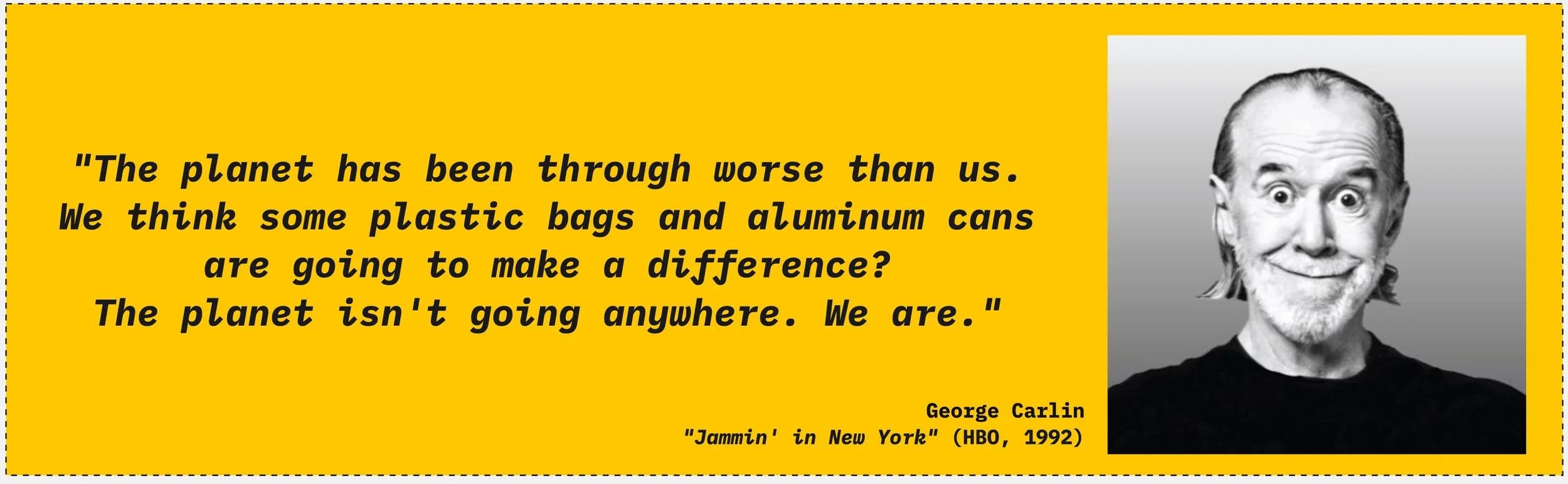
In one of his 1992 live routines, comedian George Carlin essentially put it like this: "There is nothing wrong with the planet. The planet is fine. It probably even wanted us to invent plastic. So compared to the people, the planet is doing great. Been here four and a half billion years. But the people on it, they are fucked."
The environmental argument against AI is often less about the planet than it sounds. As George Carlin said: The planet will continue with and without us. The argument in AI discussions is actually about what's underneath: us humans as the topic. Specifically the version of us that knows how to do our work, and isn't sure whether the work survives.
Where's the Cheese?
The book has a closing scene. The storyteller and a group of old classmates sit together after he's told them the parable, and they start talking about their own situations. About what they're actually defending when they refuse to move.
Most AI conversations tend not to reach that scene. They stay at the level of the argument because the argument is more comfortable than the admission underneath.
The anxiety itself is well-documented. Researchers have started giving it names ("algorithmic anxiety", "AI Replacement Dysfunction"), and surveys from places like EY show that the majority of US employees report some version of it. What's less examined is the form the anxiety takes in conversation. Specifically: how often it arrives dressed as something else.
The admission underneath is (probably) usually some version of: "I don't know if my role exists in three years. I don't know what stops being mine if this tool can do it." That's a legitimate, material concern. It deserves to be in the room.
But it rarely arrives in its own clothes. It arrives as environmental concern. As bias concern. As craft concern. As ethical line-drawing about which AI use is acceptable. The moral vocabulary works because it's hard to argue with caring about the planet. The role-anxiety vocabulary doesn't work, socially, because admitting "I'm scared for my job" is risky in most workplaces. (And not saying we shouldn't discuss environmental impact, to be clear. It's a bit like the conversation about saving the rainforest vs. saving ALL the forests)
So the conversation runs on moral language while the actual question "what happens to me if this tool reorganizes my work?" rarely gets surfaced. The result is a loop. The position holds because it isn't the thing being defended. The thing being defended is too tender to put on the table.
AI accelerates this because AI touches role-shape so directly. The senior developer with a position on Copilot (a code-AI assistant) is often not having a Copilot conversation. The Product Manager with a position on Gamma (an AI deck-builder) is often not having a Gamma conversation. They are each having a conversation about their own legitimacy in the next version of their workplace, in vocabulary that lets them avoid saying so.
This isn't an accusation. The defense is simply said: human. The cost is that the conversation can't move past the moral layer to the actual layer, where something could be decided.
What's my Cheese?
The sharpest version of this pattern shows up in a role that, on paper, should be the most immune to it: the Agile Coach.
"AI will replace me as a Scrum Master" posts have been flooding feeds, forums and articles. (Or of other roles, of course!)
The statement, made by someone whose discipline is literally the practice of adapting to changed circumstances, is the cleanest example of role-anxiety-in-moral-clothing available. The discipline disallows the honest version. "My role is being reshaped and I haven't worked out what stays, what goes, what becomes new" is what's underneath.
"AI will replace me" is the catastrophe-frame that skips the work. (Includes me! The position I currently hold probably won't look the same in two years. Whether it disappears, who knows. But transformation of the role is meant to be part of what this job is about.)
Scrum.org's 2023 survey found that 80% of Scrum Masters thought AI could help their work, 12% felt threatened by it. Gartner estimated AI could handle around 30% of agile documentation by 2026. The rest stays in human hands: psychological safety, complex facilitation, organizational reading, the hard conversations.
(Let's keep in mind here that the survey is from 2023! It's probably very different by now.)
The structural paradox sits one layer deeper: the Scrum Master role was always meant to be temporary at the team level. Teams are supposed to grow out of needing it. Why wouldn't that be true at the discipline level too? Why would the discipline whose central tenet is "inspect and adapt" be the one exception to inspection and adaptation?
There's a strange sub-genre worth naming inside this paradox: the Agile Coach who builds an environmental case against AI. Adaptation is the discipline's central tenet. Environmental adjudication is not. When did "inspect and adapt" come to include "weigh the carbon cost of a colleague's workflow choice"? Environmental concerns are real. They belong in conversations about energy policy, regulation, data center siting. They don't belong in a meeting where the question on the table is whether someone has tried the tool (properly). The smuggling-in of moral vocabulary that doesn't belong to the discipline is the cleanest tell that the actual concern is about something the discipline doesn't allow you to name.
Scrum.org's recent AI4Agile Practitioners Report notes that practitioners worry less about losing their jobs than about "the erosion of Agile values, loss of human-centered collaboration, and reduced critical thinking."
So…Different cloth, same shape.
About a year before writing any of this, I would have been the same person. The reason that changed was that my surroundings enforced a piece of AI-Cheese into my mouth and made me chew it. The honest sentence I have for AI after a year of using it isn't "this changes everything!". It's: "Tastes different. Not bad!"
So, a coach who refuses their own coaching is still a coach. Just a slightly less convincing one.
Who moved my Cheese?
The cheese moves. It always has.
What's new is that the test for whether someone is actually following it is short: 15 Minutes with a tool either changes the workflow or it doesn't.
Most of what passes for engagement right now meets that test badly. Positions get taken. The lights stay on. The room stays the same. The longer the conversation stays on camp-membership and the ethics of someone else's email habits, the more obvious it becomes that the conversation isn't really about the cheese. It's about what changes for us if we follow.
For most people, that question is allowed to be hard. For those who do this work professionally (Coaches, Scrum Masters, Agile Practitioners of any flavor), it isn't, or shouldn't be. Adaptation is the practice. The discipline either applies to itself or it doesn't.
An Agile Coach who doesn't want to successfully meet a change as large as AI may need to think about the line of work they do.
I mean: Change is the job description.
The cheese moves. Are you following? Book a free consultation call: