The Iron Triangle
If Not Now, When Then?
There's something I keep saying: half-ass. It's when someone does something and s:he does it badly. It's something I personally just despise.
Not the kind that comes from learning. Adventure Time's Jake the Dog had a clean line on this: "Dude, sucking at something is the first step toward being sorta good at something." The half-ass that comes from trying is absolutely fine. It's how skills begin!
I mean the other kind. The kind where someone could do the thing well and chose not to. The kind where Care barely, if ever, showed up. The kind that looks finished and falls apart when used. That's the version that earns the word "half-ass".
What follows is about what happens to that distinction when the conditions around the work get rearranged faster than the people doing the work do.
The Rules
Time, Cost, Quality. You can only pick two.
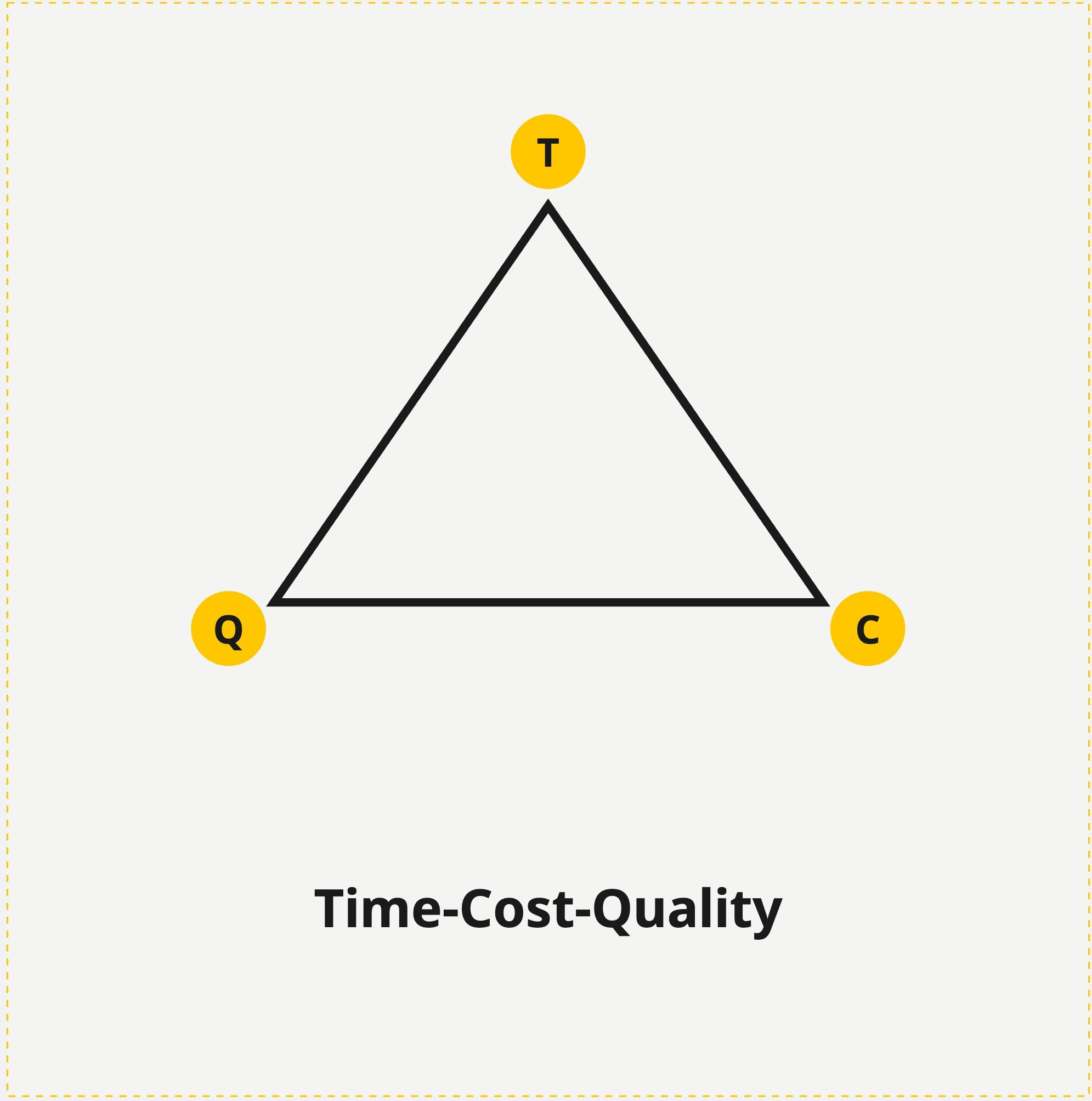
That's the game project work has been running for fifty-some years. The rule was simple. The trade-off was visible. The choice was conscious, or at least conscious enough that someone in the room could name which corner was being given up on.
The game worked because the conditions held: Building something physical took time you could measure. Cost showed up as money you could see leaving an account. Quality had a meter, even when the meter was crude: did the thing function, did it last, did the people who used it come back. Three variables, three meters, one rule.
That's no longer the world the game is being played in.
The Cards
AI rearranged the table the game was being played on.
Time isn't what it was in 1969. A draft that took three days now takes 20 minutes. A prototype that took two months now takes a weekend. "It'll take a week" used to mean a week of constant human attention. Now it can mean a week of waiting for someone to remember the prompt window is still open.
Cost isn't what it was either. The same draft that took three engineer-days at engineer rates now takes one engineer-hour and a subscription fee. The distribution of who pays for what has shifted in proportions no historical project plan accounted for.
Quality is the corner that got the most awkward. The meter was already vague before AI. Now the surface is harder to read than ever. Things look polished and are broken. Anything can have any surface attached to it at no cost.
Three variables. None of them under 1969 conditions anymore. The triangle that organized work for a generation is sitting on top of a different physics. Plus the parts that didn't move.
The Figures
The half-assly-done is still there. Same shape. Same outcome. Slightly different mechanics.
The triangle was, from the start, partly a moral story dressed as a project-management one. "Pick two" was the polite way of saying: be honest about what you're sacrificing. The corner that gave was supposed to be named. When it wasn't, the result was the version of work that earned the word: half-ass.
That part hasn't adjusted to AI. AI changed the variables. AI didn't change the Care arithmetic underneath them. Someone who would have shipped half-ass at human speed now ships the same at AI speed. The output is the same kind of empty, just produced faster and at greater volume.
The question isn't really about Time or Cost or Quality anymore.
The Playthrough
Robert Pirsig, in his 1974 philosophical novel Zen and the Art of Motorcycle Maintenance, spent half the book trying to define Quality. He failed. Though on purpose. “Quality”, he eventually argued, “is undefinable but recognizable”. It sits before the split between the perceiver and the perceived. It lives in the moment of contact between a person and the thing they're working on.
The opposite of Quality, in his framing, isn't "low quality." It's indifference.
The project-management literature reached the same conclusion from a different angle. Roger Atkinson's 1999 paper in the International Journal of Project Management argued that Time and Cost were "best guesses", while Quality was "a phenomenon, an emergent property of people's different attitudes and beliefs."
Translation: you can budget Time and Cost. You can't budget the thing that emerges between a person and their work. Pirsig from outside the discipline, Atkinson from inside it, both pointing at the same hole: Quality.
That's the whole game. A beginner with full Care produces something rough that nonetheless has Quality, because Care is in it. A skilled person with Indifference produces something polished that has none, because nothing of them is in it. Skill decides the surface. Care decides whether anything underneath holds together. Care is also the thing that adjusts to what's in front of it. Indifference doesn't bother.
There's a personal twist that has to go in here too: the Quality failure mode runs in more than one direction. Perfectionism is its own version: the unreasonable amount of time spent finding "the exact right tupperware system" (scalable, modular, durable) that ends with no tupperware bought at all, if not the perfect one. Care that doesn't ship is also indifference, just wearing caring's mask.
So there are at least three failure modes around Quality:
Indifference that ships sloppy. Perfectionism that ships nothing. The polite middle that calls itself "pragmatism" but is often neither.
The Pieces
A consultant posted on r/SaaS recently: A non-technical founder ships an AI-built app. Each individual function passes review. The system underneath doesn't hold together. Weird abstractions, basic stuff missing where it matters, migrations bolted on as afterthought. Their line: "You can speed up the typing but the systems thinking has to happen somewhere or it gets paid for later."
They were excited, because their consulting rate was going up. This happened to them in 2010 too, with offshore contractor work. Same pattern, new costume. The triangle still says "pick two", but AI bills it later. Cheap doesn't disappear. It defers. The corner that was supposed to give, gives. The only difference: the giving happens out of sight of the person who chose the trade.
One actor adjusted to the new tooling fully and didn't update their model of consequence. The other adjusted both, and now charges for the gap. Adjusting to the conditions around the triangle is the variable that's actually being tested. By picking two, the conscious decision is what it had to be: whatever you choose, the third is what will cost you. If not now, it will later.
The Reshuffle
Somewhere between 1969 and now, 'project work' tried to fix the triangle without changing the geometry. DSDM (the Dynamic Systems Development Method, an agile framework from 1994) was the first to do it explicitly: fix Time, Cost, and Quality at the outset, let Scope be the variable. MoSCoW prioritisation (Must, Should, Could, Won't: a way to rank what has to be in this iteration and what doesn't) operationalised the move. The Agile Manifesto of 2001 didn't say this anywhere, despite the common belief that it did. Pick two, but the two are pre-selected.
This was a real fix for a real problem. Locking Scope had produced late, over-budget, miserable projects for decades. Letting Scope flex meant the stakeholder-feedback loop could shorten the gap between "what we thought we needed" and "what we actually need now."
What the reshuffle didn't fix is what the original didn't fix: Quality is still without a meter. "Quality is fixed" turned out to be an aspiration, not a mechanism. Definition of Done plus a stakeholder-smile is a surface check. Not a Care check.
So the polite lie moved house. The 1969 version pretended Quality could be picked or sacrificed.
The Agile version pretended Quality was now safely fixed.
Same lie, new floor.
For someone whose own discipline is Agile, that's worth saying out loud. The reshuffle was a step, not the destination.
The Add-On
So the rule still functions. But the picture it draws is too small for the work being done now.
Even PMI, the institution that codified the triangle in PMBOK (its Project Management Body of Knowledge standard), eventually let it go. PMBOK 4th Edition (2008) expanded the model to six constraints. PMBOK 7th (2021) dropped the triangle altogether. A paper published through PMI (Baratta, 2006) went further, calling the triple constraint's principles "both erroneous and useless." The model didn't just outgrow itself in the wild. It outgrew itself inside its own institution!
There's also a quieter correction worth making. Quality was never really one of the three variables. In my honest opinion: it was Carewearing Quality's name. Pirsig knew it. Atkinson knew it. The meter problem proved it. And AI exposed it. You can't pick Quality the way you pick Time or Cost. Quality shows up when Care is in the work, and doesn't when it isn't. Putting Quality on the corner of a triangle as if it were trade-able was the polite lie the model needed.
So if 1969 it was three corners (with Quality as the stand-in for Care), for 2026 it's six:
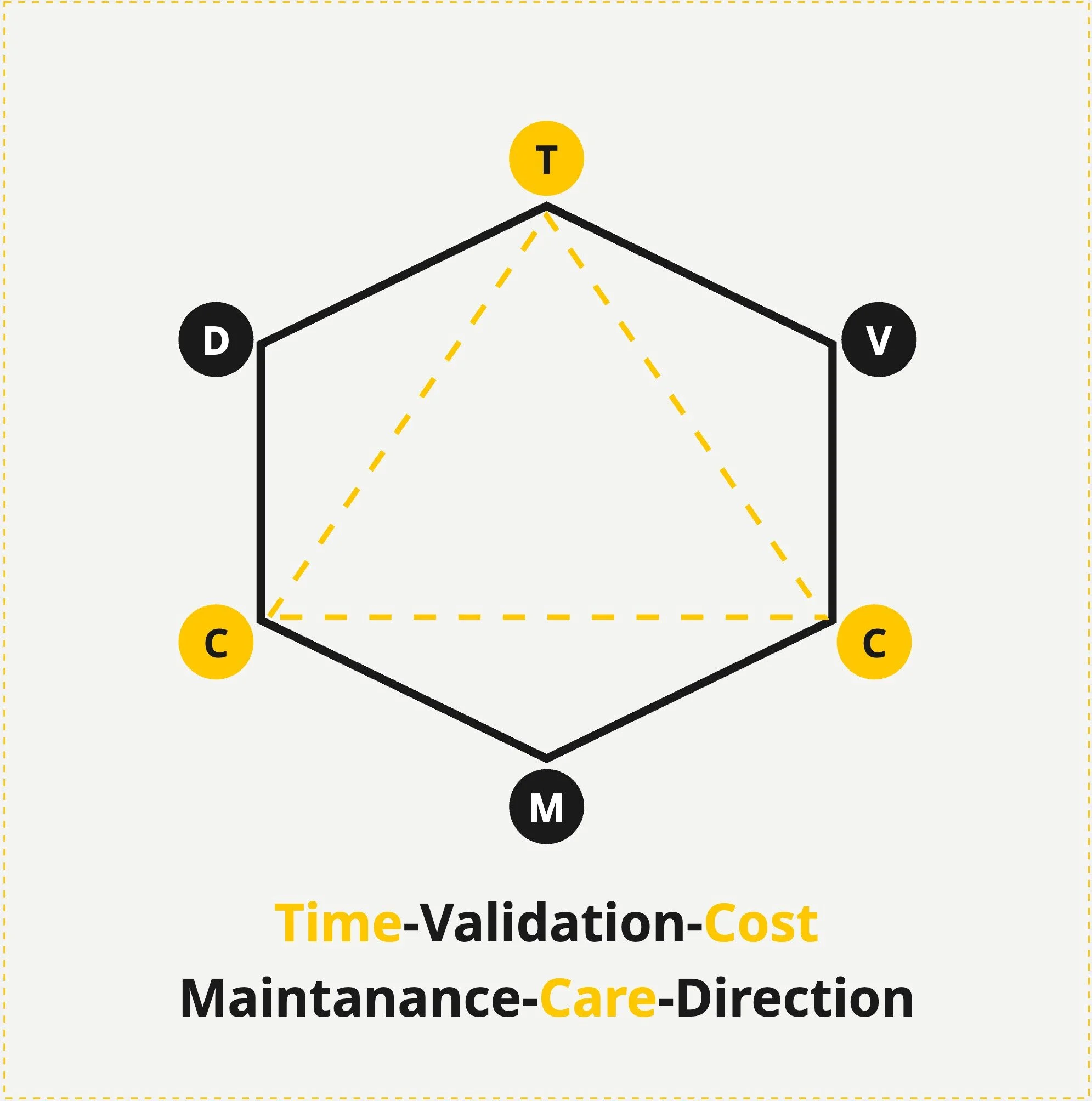
1. Time
2. Cost
3. Care (the input that produces what we used to call Quality)
4. Validation (who checks whether it actually works)
5. Direction (are we building the right thing in the first place?)
6. Maintenance (who keeps it working after launch)
The hexagon names Care as the thing that was doing the work the whole time.
Four of those are corners that used to be implicit, hidden mostly inside Time. Building used to take long enough that Care, Validation, and Direction got built into the process by friction. AI removes the friction. What used to require Care now happens optionally. The AI will build whatever was asked for, even when what was asked for isn't what was needed.
A triangle balances on a tip and fits on a serviette. A hexagon rolls flat. Six points, no clean pick-two option. The model that worked when there were three corners worth managing doesn't work when there are six, and four of them have no meter at all.
There's a more specific geometric move worth noticing. Drop the old triangle inside the hexagon, and the three original corners still fit on every other point. Between each of the old corners, a new one has slid in. Cost is no longer Time's direct neighbour. A new corner has wedged itself into every direct trade-off. The old Time-vs-Cost conversation can't happen anymore without something else sitting in the middle, asking its own question first. Just how AI is now sitting in most of the conversations around the work.
Which new corner sits between which old one is still up for arrangement. It depends on the project, the team, the trade-off being negotiated. Those are two possible layouts. The fixed part is the geometry itself: the original three don't get to be neighbours anymore.
The triangle didn't disappear. It simply outgrew itself.
And there is a new rule of the game, parallel to the old one:
There are six. You can keep maybe three in real focus. The others, AI will fill in for you. They won't hold.
The corners that don't get Care will be sacrificed. The only difference is that now there are more corners that can be sacrificed at once, and the sacrifice doesn't have to be named to happen.
The Joker
There's a hypothesis worth working with: I believe very few people start a job wanting to half-ass it. Half-ass shows up after some time. After enough criticism that Care became unsafe. After enough rewarded shortcuts that Care became unrewarded. After enough bullshit work that Care stopped finding anywhere to land. People tend not to begin indifferent. They become indifferent. The half-ass anyone sees is often a symptom of an earlier breaking-point, a place where adjusting to the conditions stopped paying back, and people quietly stopped adjusting.
There's a second form of half-ass that the same system treats very differently. The version that withholds Care from the people who do the work, while still delivering Time and Cost and the appearance of Quality. The system tends not to despise this version. It celebrates it.
The most familiar version is the Steve Jobs one: a founder gets to be an asshole to his employees because "he made it happen." The pressure and the unrelentingness become the explanation. The relation is false: the success more likely happened despite how people got treated than because of it. But the paradigm needs the link, because the link justifies the demand: stay up, work harder, become better than you actually are. Otherwise there's no room left for the hero to exist.
Half-ass shows up in two costumes. One gets called sloppy and earns contempt. The other gets called visionary and earns a biography. Both withhold Care from somewhere. The model doesn't distinguish, because the model only measures what shipped, not who shipped it or what it cost them.
If the breaking-point hypothesis holds even partially, then the AI slop flooding the internet is a mass indicator. Many people are at or past breaking-point, and AI removed the friction that used to force them to either fake Care themselves or produce nothing at all. Now they don't need to fake it anymore. The AI does the faking for them. The output looks like work at first glance. Underneath, nobody is home. That's what AI slop is.
This isn't AI's fault. AI didn't break the people. AI gave the broken a megaphone. Earlier technology cycles that lowered friction between thinking and producing produced their own version of slop. AI's slop is louder because the friction it removed was bigger, and faster. So much faster.
The question I have no answer to is whether the people producing slop are choosing it or whether they ran out of conditions in which Care was possible. Probably both? Probably not equally? Worth distinguishing case by case, because the response is different. One needs accountability. The other needs repair.
The Endgame
The variables adapted. Time isn't 1969 Time. Cost isn't 1969 Cost. The third one, the one we used to call Quality, turned out to be (in my honest opinion) Care under a different name, and Care didn't have a 1969 meter either.
Half-ass didn't adapt to any of that. It operates on a different axis. It was there before AI, it's there during AI, it'll be there after AI. The decision to bring Care or not bring Care sits underneath all of it and doesn't get easier or harder depending on which decade is happening above.
For anyone running teams, projects, or organizations, the work that comes out of this isn't about the triangle. It's about Care. Whether the people doing the work have any. Whether the conditions allow it. Whether the metrics reward it. Whether the speed-up from AI gives people room to care, or whether it just gives them more output without the caring.
The model has adapted. The work has adapted. The question is whether we adapt with them, or whether we keep drawing the old triangle on the serviette and call that a strategy.
That part is still ours, purely human-(h)ours.
Does your Team Care? [ Book a free consultation call ]