Verified and Certified
But Qualified for What?
When someone cuts you off, swerves across two lanes and brakes for nothing, you know exactly what comes out of your mouth.
"Where did you even get your license?!"
Well, we all shout some version of it at least. And it is a strange thing to shout, because the person clearly has a license. That was never the complaint. The complaint is that the license and the actual driving turned out to have nothing to do with each other.
So last week, when a new job title rolled past me in my feed, the same words came up. Loop engineer: the person who designs the feedback loops an AI agent runs in, the act, check the result, adjust, repeat cycle that lets it work on its own. Before that it was context engineer. And before that, prompt engineer. The AI world is printing titles faster than anyone can define them, each one arriving with the calm confidence of a profession that has been around for decades. And I caught myself reacting the way you would to a bad driver: where did this one get their license?
Because a job title is basically a license. Right?…Right?
Starting an Engine
Let me get one thing out of the way, because it matters. Titles, and the qualifications behind them, are fine. This isn't me telling you certificates are worthless or that certified people are frauds! A license is genuinely useful. It just answers a much smaller question than we like to pretend.
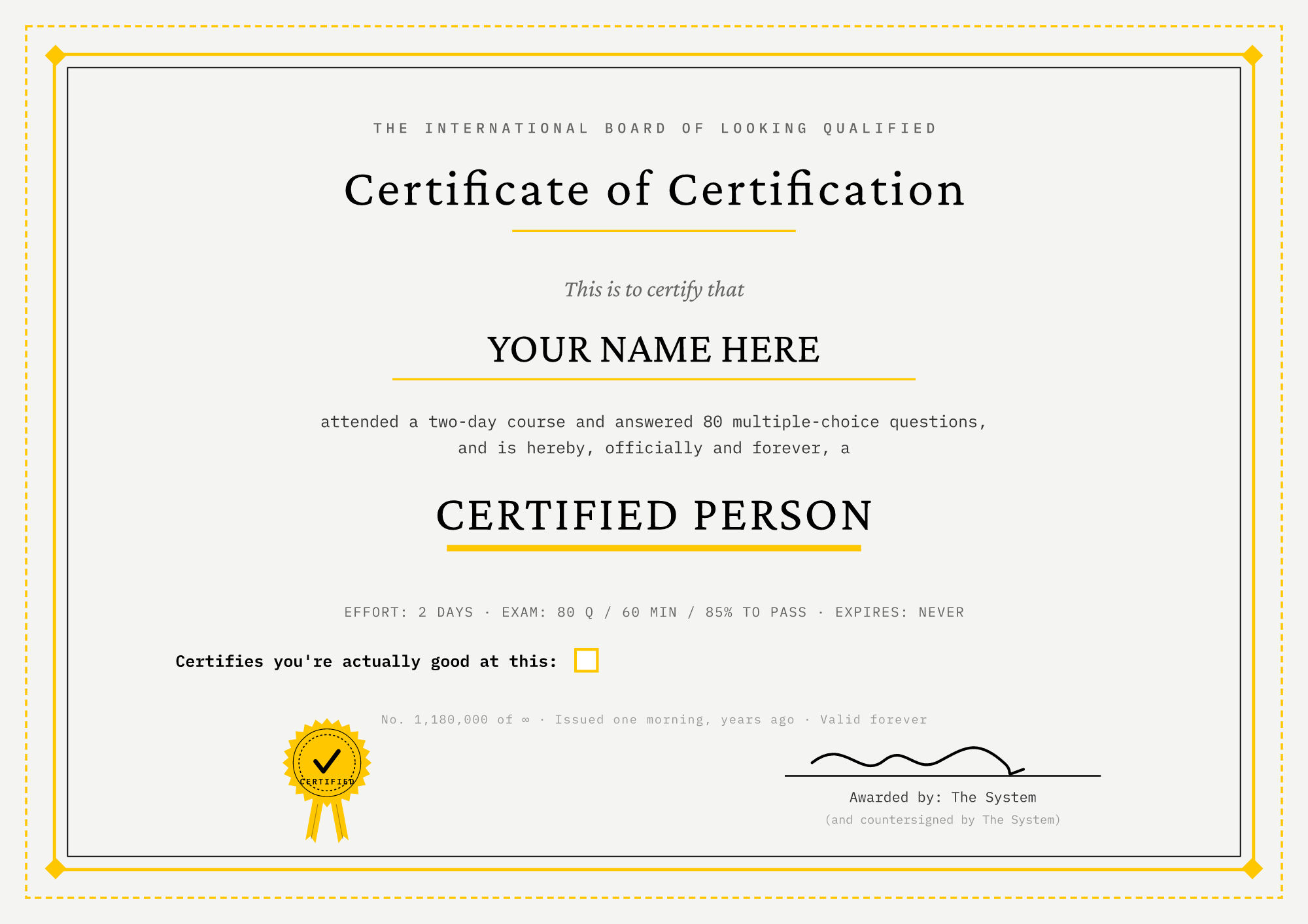
And I should come clean, because I am standing in this glass house too. I am a certified Scrum Master. Sat the exam at university, half by accident, barely revised, and passed on the first try. Eighty questions, sixty minutes, eighty-five percent minimum needed to pass. That was years before I had actually run anything. That certificate never expires. It is still valid today, sitting in some database, quietly insisting I am qualified, with no idea whether I ever got good at the job.
So when I pull on this thread, I am pulling on my own card first. Because there are two questions hiding inside any title.
What did it take to get it? And, are you actually any good at it?
They rarely have the same answer. A title only ever speaks to the first one. And sometimes, as I just mentioned, not even that.
Down a Road
Take the first question, the one about effort. You would think a title at least nails that part down. It doesn't… And the cleanest proof is a job with roughly the same purpose everywhere on the planet: the police officer.
Keep people safe, uphold the law. Same badge, same mandate, Berlin or Boston. Now look at what it takes to pin that badge on. In Germany, you train for two and a half to three years, somewhere near four thousand hours (and more). In the United States, the average police academy runs about eight hundred hours, so roughly twenty-one weeks. Same title. Same job. And a hurdle that swings by a factor of five or six depending on which side of an ocean you happen to be standing on. And to be clear, I am only counting training hours here, not how the job actually gets done on either side. That is a bigger, very different conversation.
Now park a doctor next to that. Four years of medical school, then three to seven more in residency before anyone lets them practice alone. A doctorate always means a dissertation, years of it. That is a real hurdle, and I would never talk it down.
And then, in the exact same job market, stands a Scrum Master. (Scrum is the framework most teams use to organize their work, and the Scrum Master is the person meant to help them run it well. Becoming a certified one can take a two-day course and that multiple-choice test I mentioned). Eighty questions. One provider alone has certified over 1.18 million people, up from around ninety thousand a decade ago. The certificate cannot expire, so that number only ever moves one way. By now I have helped multiple people prepare for the Scrum Master testing, knowing full well they are only doing it for the certificate, not to actually become Scrum Masters. And that is fine…To a Degree. (Pun intended!)
Doctor, Police Officer, Scrum Master. On the effort axis they wear the same label, "certified professional," stacked on top of wildly different licenses. All of them sitting in the same wallet, right next to the one for your car.
At the Wheel
But effort was always the easy axis. Here is the harder one, and it bites at every level, not just the cheap end: a title barely touches whether you are any good at the actual thing.
A dissertation proves you can do research. It says nothing about your hands at a patient's bedside. Three years of police training does not hand you good judgment in the one second that actually counts. And passing your driving test at eighteen tells you nothing about the person now tailgating you at 140 km/h with a phone wedged against the wheel, filming themselves. The license only ever said you cleared the bar once. The driving is a separate thing, and most of us have sat white-knuckled and very nervous in the passenger seat of someone perfectly, legally licensed.
So what does make someone good? For a doctor, a police officer, a coach, a loop engineer, it lands on the same short list. Judgment? Communication? Empathy? The knack of reading a situation and answering what is actually there, not what the manual says should be. Rarely that is the focus of a test.
Now, the easy move here is to shrug and say those things simply cannot be measured. Douglas Hubbard wrote a whole book against that shrug, "How to Measure Anything." His point: measuring is about reducing uncertainty, not erasing it, and if you can observe a thing at all, you can measure it. "Immeasurable" is usually just an excuse.
Which flips the problem around. Good driving can be measured. You just have to watch someone drive, for years, in real traffic, in the rain, when they are late and tired and nobody is marking them. The certificate measures none of that. It measures one morning, and then goes quiet forever. Medicine seems to know this in (literally) its bones, which is why it buries the unmeasurable part under years of supervised practice, an experienced pair of eyes in the passenger seat, before it lets you loose on the road. The two-day course skips the car entirely and mails you the license.
And if you go hunting for hard proof that the certificate makes anyone better at the job, the trail runs thin fast. Notice what actually gets sold: the pitch is that Scrum helps your team, and maybe it really does. But that is a claim about the framework, not about the piece of paper, and not about whether the person holding it is any good with it.
Rush Hour
There is a second thing that happens when a license gets easy to hand out. It quietly stops meaning much. A credential only signals something while it is scarce and hard to fake. Print enough of them and the signal flattens to "showed up." When a million people hold the identical card and it never expires, the card is less a filter than wallpaper.
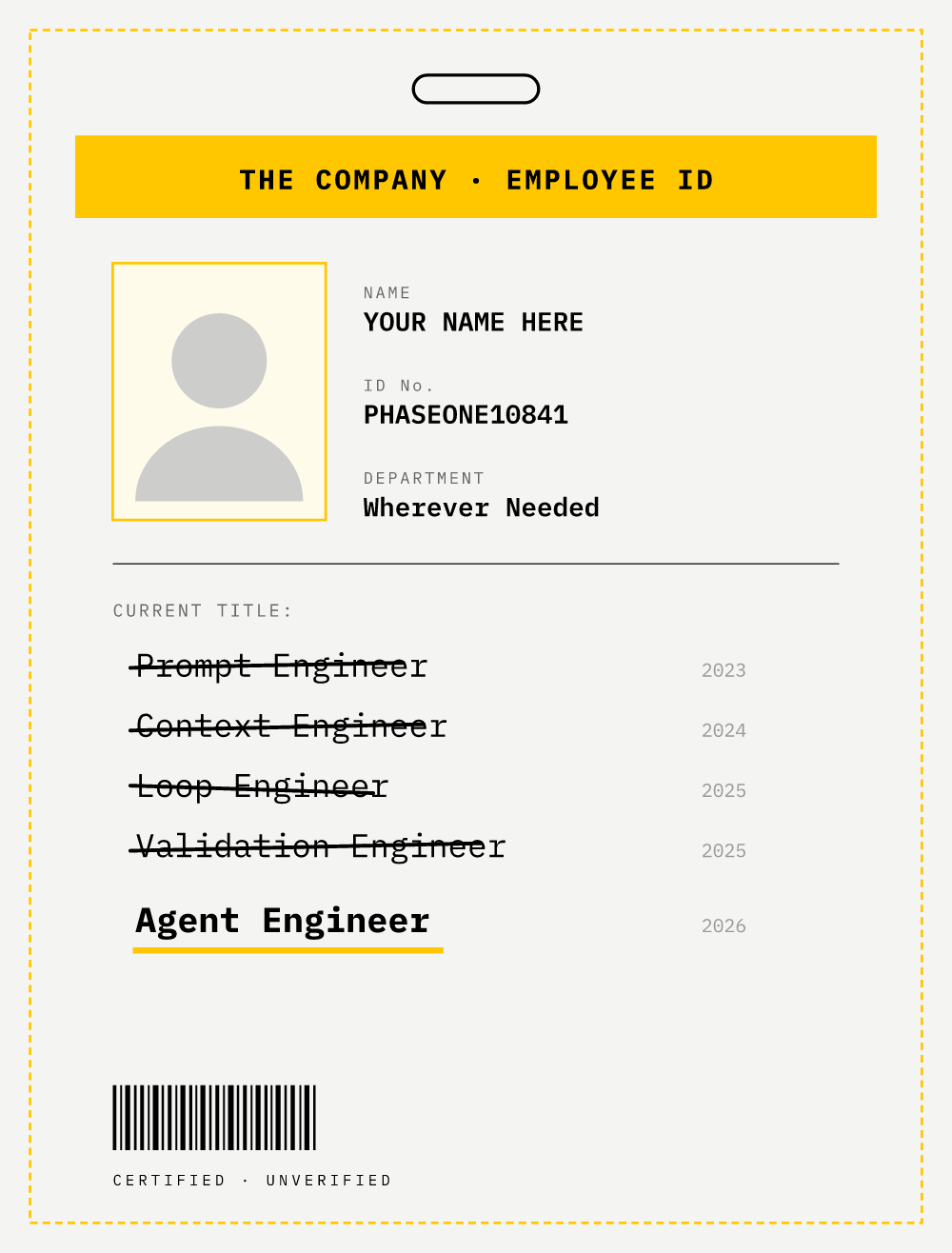
Which is, quietly, why the new titles keep coming. A fresh title is scarce again. For a little while, "certified" in the new thing carries weight, purely because hardly anyone is yet. Then the courses spin up, the card starts getting handed out at the door, the signal fades, and the market goes looking for the next shiny title to buy the scarcity back. Title, status, mass certification, devaluation, next title. The half-life of a job title.
And the lap is already shorter than when this post was drafted. Between writing it and publishing it, two more pulled up: the "AI evals engineer" (some postings just call it "validation engineer"), and the "agent engineer," suddenly listed by the big consultancies as if it had always been there. The ink was not even dry.
Full Stop
Which brings us back to the loop engineers and context engineers clogging up the feed.
We have watched this exact lap before. In 2023, prompt engineer was the hottest license in tech. Two hundred grand, "AI whisperer," no coding required. By 2025, postings had dropped by around forty percent, and a Wall Street Journal reporter went looking for someone who still held the title and came up mostly empty. The license devalued before the ink dried, mostly because the models got good enough that the "skill" melted back into ordinary work.
Loop engineer is even earlier on the road. No test yet, no supervised practice, no body of knowledge, and so no card to check. And that is the part I keep circling back to, because it quietly exposes what the certificate was doing for us the whole time. When you hire a certified anything, you get to point at the card and feel covered. Someone else vouched. Box ticked. A brand-new role takes that comfort away. There is no certified loop engineer to hire, so whoever is staring at that open job has no fig leaf left, and gets pushed onto the only question that ever really mattered: can this person actually do it? No card, no course, no eighty questions. Just their work, and your own judgment watching it.
Which is, awkwardly, how we might have been hiring the certified ones all along. The new role didn't invent the problem. It just took away the paper we were hiding it behind. The honest answer to "are you a good loop engineer?" is still "ask again in a few years," because nobody has driven that road long enough to be watched. But for once, no one can wave a card and pretend the question is already settled.
And here is the part I find oddly reassuring, not cynical. The market itself keeps pointing at where the value actually lives. The World Economic Forum's 2025 Future of Jobs report and PwC's 2026 AI Jobs Barometer both find that as AI swallows the routine work, what is left leans harder on exactly the stuff no test can catch: empathy, judgment, creativity. The “uncertifiable”, human parts are turning out to be the future-proof ones. The thing the license never measured is the thing that lasts.
None of this is aimed at the AI crowd! My own field drove this lap first, and I was in the passenger seat holding a certificate I had "barely earned".
So, honestly? Forget the certificate for a second. Most of us quietly know it only ever tells you so much. To even get a driving license, you had to sit in the car and drive, badly or well, while someone watched. My own Scrum Master exam never put me behind a wheel. The loop engineer's does not exist yet. The professional licenses skip the car and hand you the card. So there is really only one question left, and it is the same one for the Loop Engineer, the Scrum Master, and the version of me who passed that exam at university:
Can you actually do the job?
(Your surgeon, though... Your surgeon can keep every one of those years. Some cars you really do want to know were driven, supervised, for a very long time before anyone hands over the keys...)
Are you licensed to drive? [ Book a free consultation call ]